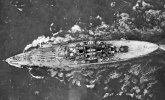
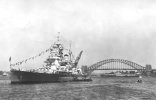
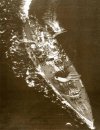
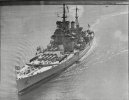
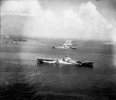
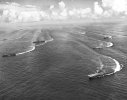
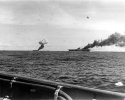
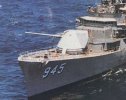
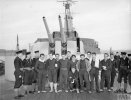
HMS Anson Pennant #79 was 1 of 5
King George V battleships of the Royal Navy. Originally to be named
Jellicoe, it reportedly never fired its main guns in anger as it was used mainly for escorting convoys to the Soviet Union. After refitting, it arrived for the very end of the Pacific War and accepted the surrender of Hong Kong from Japan.
Although usually overlooked due to its smaller 14” main guns, the
King George V was an excellent design with long range, good anti-aircraft batteries (dual purpose 5.25” secondaries) and the most heavily protected ship outside of the
Yamato class.
The main armament was a challenge, as the British were trying to adhere to naval treaties limiting new construction to 14” guns. Originally, 3 quadruple turrets were envisioned but staying within 35,000 tons as well as topweight issues changed the superfiring turret to a twin. As noted above, the turrets/guns proved problematic (interestingly, the guns were evenly spaced unlike the French
Richelieu which had a larger gap between the middle guns as it was divided into 2 two gun sets).
The US went down the same road with the
North Carolina class, but having the luxury of more time, the US battleships were delayed long enough so the escalator clause came into effect and 9 (3x3) of the excellent 16”/45 caliber Mark 6’s were selected.
Length: 740 ft, Beam: 103 ft, Displacement: 45,000 tons at full load.
Powerplant: 8 boilers made 110,000 hp (overload to 134,000) with 4 shafts gave 29 knots (it was one of these shafts that got hit by a Japanese torpedo that went out of control, demolishing bulkheads and led to uncontrolled flooding and the sinking of the
Prince of Wales as part of Force Z in Dec 1941.
Main Armament: 10x14”/45 caliber cannons firing 1,600 lb shells to 38,000 yards.
Secondary: 16 (8x2) 5.25 cannons
Anti-Aircraft: multiple 2 pounder (a low velocity 40 mm) later supplemented with 40mm Bofors. Many 20mm Oerkilons.
Armor: Main Belt: 14.7 inches, Deck: 6 inches.
Commissioned on 14 April 1942, stricken on 18 May 1957.
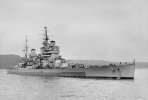
HMS
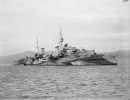
Anson at Devonport, March 1945
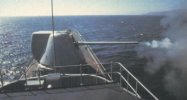
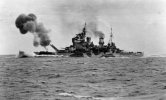 Anson
Anson firing her guns during target practice in the North Sea.
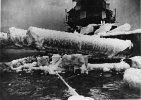
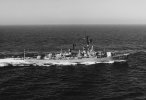
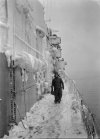
HMS
Anson while on Russian convoy duty