The Squadron of Evolution
By 1881, the once mighty US Navy that carried the nation through the Civil War had withered from a fleet of 600 ships in the 1860s to one that was barely fit to be called a navy. There were good reasons, westward expansion and the rapid rate of industrial development pulled attention from the armed forces, and the nation still carried memories of the war. The deterioration was to such an extent that the US Pacific Squadron was threatened by Chile if it interfered with their war with Peru. Within the fleet, aging admirals wedded to their greatest days gone by clung to obsolete wooden ships, coastal monitors and riverine gunboats that would no longer serve the vital needs of the country. Gradually, industrial and commercial interests, and the US Congress, began to think of the broader aspects of US maritime presence and of a navy to support and to protect such a presence - driving them was the recently published book “The Influence of Sea Power upon History, 1660–1783,” by Alfred Mahan.
Memoranda and reports were circulated among the various committees in Congress and the Department of the Navy promoting a fleet of ships, and a corps of officers, not consumed with sail power nor hampered by tradition. From this activity, the administration of President Chester A. Arthur established the Office of Naval Intelligence in 1882, signed the Naval Act of 1883 and opened the Naval War College in 1884. Cheering from the sidelines was the future Secretary of the Navy and President, Theodore Roosevelt.
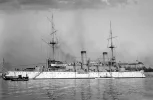
The act of 1883 authorized four steel hulled ships - three protected cruisers and a dispatch vessel. Soon, three smaller vessels, all of the same class, were added to the other ships. The protected cruisers were commissioned in 1886, 1887 and 1889 and were all of separate design. The three "gunboats" of the Yorktown-class were based on a Royal Navy cruiser design, the HMS Archer-class of eight ships. These three were commissioned in 1889 and 1891. One other actual gunboat and five unprotected cruisers were in commission from 1890 to 91. All were designed to “teach” the U.S. Navy how to operate and maintain steel ships while simultaneously giving it a global reach.
Among the lessons learned was a need for permanent bases for coaling which gave us Pearl Harbor, Midway, Wake, and eventually Guam and the Philippines. Although the fleet never fired a shot in battle, it was a pivotal moment in American naval development.
The cruisers were;
USS Atlanta, 1886
USS Boston, 1887
USS Chicago, 1889
The Yorktown-class were;
USS Yorktown, 1889
USS Bennington, 1891
USS Concord, 1891