• Please take a moment and update your account profile. If you have an updated account profile with basic information on why you are on Air Warriors it will help other people respond to your posts. How do you update your profile you ask?

    Go here:

    Edit Account Details and Profile

Ship Photo of the Day

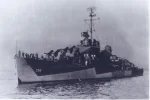
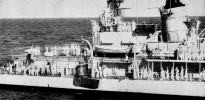
Perhaps the single greatest display of anti-aircraft gunnery of WW2 came from the Sumner class destroyer USS Hugh W Hadley DD-774. While on picket duty off of Okinawa with the Fletcher class destroyer USS Evans, the 2 destroyers were attacked by over 100 Japanese aircraft on May 11th, 1945.

Using 1940’s era radar and computing, her six 5”/38 caliber cannons firing proximity fused shells, along with twelve 40mm Bofors and eleven 20mm Oerkilons shot down 23 attacking Japanese aircraft. (USS Evans shot down 15 as well) Ultimately, a couple of kamikaze airplanes got through as ammunition ran low and then a rocket propelled Ohka with a 2600 lb warhead finally put the destroyer out of commission, although she remained afloat and was towed home.

(my late uncle was a radarman aboard USS Oberrender DE-344 mentioned at the beginning of the article - she too was hit by a kamikaze and knocked out of the war)
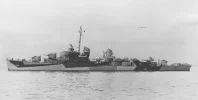

1781451553895.jpeg
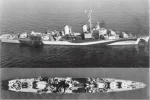
USS Hugh W. Hadley

1781451628668.jpeg
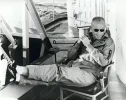
San Diego, CA area 23 December 1944 to 20 February 1945 period.
1781451707877.jpeg
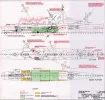
Battle damage diagram dated May 11 1945.
1781451764158.jpeg
 
Last edited:
Perhaps the single greatest display of anti-aircraft gunnery of WW2 came from the Sumner class destroyer USS Hugh W Hadley DD-774. While on picket duty off of Okinawa with the Fletcher class destroyer USS Evans, the 2 destroyers were attacked by over 100 Japanese aircraft on May 11th, 1945.

Using 1940’s era radar and computing, her six 5”/38 caliber cannons firing proximity fused shells, along with twelve 40mm Bofors and eleven 20mm Oerkilons shot down 23 attacking Japanese aircraft. Ultimately, a couple of kamikaze airplanes got through as ammunition ran low and then a rocket propelled Ohka with a 2600 lb warhead finally put the destroyer out of commission, although she remained afloat and was towed home.

(my late uncle was a radarman aboard USS Oberrender DE-344 mentioned at the beginning of the article - she too was hit by a kamikaze and knocked out of the war)


View attachment 45166
USS Hugh W. Hadley

View attachment 45167
San Diego, CA area 23 December 1944 to 20 February 1945 period.

View attachment 45168
Battle damage diagram dated May 11 1945.

View attachment 45169
Excellent post. The fights all along the Okinawa picket line were remarkable for their ferocity. When all things are considered, especially the casualties, it is impressive we lost so few ships (actually sunk).
 
Excellent post. The fights all along the Okinawa picket line were remarkable for their ferocity. When all things are considered, especially the casualties, it is impressive we lost so few ships (actually sunk).
Amazing that those 2 destroyers took out 38 attacking aircraft - compared to just 5 years earlier half as many airplanes sank Force Z’s battleships Prince of Wales and Repulse. Wonder how the Pacific campaign, and warship design in general, would have changed had the proximity fused shells been in wide use at the beginning of WW2.
 
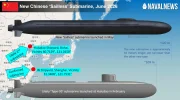
Not a photo -- yet -- but nonetheless an interesting new Chinese PLAN SSN design that is under construction in North China. Only a small hump in place of the traditional submarine sail. This graphic compares the new design (designation not yet known) with the Type 095 SSN.

SSNs Type 95 and new larger boat.png
 
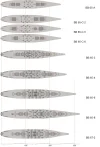
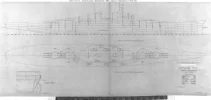
Today being Father’s Day, perhaps a look at the “Big Daddy” of US battleships, the never completed 5 Montana class bruisers. In particular, the largest design seriously considered was BB-65-8. Guns?, Armor?, Speed? Yes.

Length was 1,050 ft, Beam 116 ft and displacement at full load was hitting 80,000 tons.

12 (4x3) of the most excellent Mark 7 16”/50 caliber cannons were the main armament. Although an 18” weapon was considered throwing a monstrous 3,800 lb shell, only 8 could be carried versus the 12 16” cannons with 2,700 lb shells. The standard 20 (10x2) 5” cannons were the secondaries - although these were the new 5”/54’s with bigger shells and 50% greater range. As usual, as many smaller anti-aircraft guns that could fit, although by the time these ships would have been ready, the new twin 3” automatic cannons with proximity shells would replaced the quad 40mm Bofors and the powered Thunderbolt quad 20mm would have replaced the single 20mm Oerkilons - a defense that propeller airplanes would have extreme difficulty penetrating.

Armor was a massive 15.3” external belt (25% greater than the Iowas) with 6.2” of deck armor.

Horsepower was estimated at 320,000 SHP (50% more than the Iowas) to drive these leviathans at 33 knots - interestingly it would have required 6 shafts.

1782054993832.jpeg


1782055141240.jpeg

From the Youtube website Grim Reapers which specializes in naval battles, one can see the fully designed models with both 16” and 18” guns.

 
Last edited:
Back
Top