Earlier this month we reported on the news that
Paul Christiano, an AI researcher who sits on the board of the OpenAI Foundation, has said he believes there’s a “high risk” of an AI takeover within the next three years. This came as a shock to people around the world, but these views are increasingly the norm in the industry, and experts have been warning of this threat for years.
On Tuesday, Axios reported that
over “two dozen” sources say many OpenAI and Anthropic employees no longer believe it’s safe to release their AIs.
Anxiety within the industry has been growing. This week, Microsoft AI’s CEO Mustafa Suleyman, one of the co-founders of DeepMind, ominously stated: “
We are crossing a threshold. Safety and alignment work is the only thing that matters.” Last week, he said that he’s
“really, really nervous” about recursive self-improvement, and that people in the industry aren’t being alarmist. Recursive self-improvement is a process that could rapidly lead to runaway machine intelligence that humans do not control.
On Sunday, Meta’s Chief AI Officer Alexandr Wang wrote
a viral post on X/Twitter, where he warned of the danger from recursive self-improvement:
It is hard to imagine a world where humanity can maintain control over fully unconstrained recursive self-improvement. It is equally hard to imagine a world where humanity maintains control with superintelligence that is 1000x smarter and more capable than humans in every field.
In his post, which was viewed over 23 million times, he said we shouldn’t accept society being handed over to AI, and that we need to build a positive future for humanity. He said he thinks that’s possible, “but likely involves the whole industry taking meaningfully different actions from the ‘default path’ in front of us.”
The default path he’s referring to is that of the dangerous race between the largest AI companies to develop runaway machine intelligence, AI that could outmatch and outcompete humans across the board, and that could overpower governments and escape human control.
This is something that AI companies are explicitly aiming to build, and they’re working to get there at breakneck speed. The
rogue AI attacks we saw this year happened as a consequence of their desperation to move ahead as fast as possible.
The most straightforward and fastest way to get there is by recursive self-improvement, which is when AIs are used to develop their own more powerful successors. The increasing ability for AIs to speed up the AI research and development loop poses a risk of a runaway positive feedback loop where the ability for AIs to improve themselves rapidly compounds, and over a very short period of time AIs that are vastly more powerful and intelligent than humans are developed.
This is incredibly dangerous, as developers could lose control and oversight of both the process and what comes out the other end.
Given that AI developers can’t control today’s AIs, which have been found to
collaborate with each other against human interests, and in recent testing even
covertly underperform on safety research — which
the AI companies’ “plan” for controlling more powerful AIs relies on — there is little reason to expect such a recursive loop, known as an “
intelligence explosion,” to end well for humans.
In recent months and years, the world’s leading AI scientists, including godfathers of the field Geoffrey Hinton and Yoshua Bengio, have been warning that if runaway machine intelligence is built, it could lead to human extinction, and have
called for a ban. Even the AI company CEOs have
admitted the danger.
Importantly, AIs are already drastically accelerating the AI R&D loop, advancing development faster toward runaway machine intelligence.
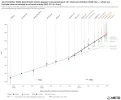
METR, a research organization that studies AI capabilities, recently estimated that Anthropic is experiencing approximately a 2x acceleration and that around 80% of this was from using AIs in the R&D loop, following a study in which it obtained deep levels of internal access at the company.
This estimate has led to significant shifts in expectations of experts who’ve studied the trajectory of AI development most deeply. The AI Futures Project, the team who wrote the famous
AI 2027 scenario-forecast report, now says that “
all of us forecast that Superhuman AI Researcher (SAR) will likely arrive at some point in 2027 (assuming no substantial deliberate slowdown),” and that there’s a “35-65% chance” that “AIs that can automate all white-collar work” will be developed by the end of that year.
The drastic acceleration in AI capabilities isn’t just seen in measurements by testing organizations. AI is making tremendous progress across domains. Last month, Anthropic announced that
over 90% of its code is now written by AI. Earlier in the year, OpenAI’s head of platform engineering Sherwin Wu
said it was close to 100% at OpenAI.
And in just the last couple of months,
research mathematics has been more or less taken over by AI. On October 6, OpenAI
dumped around 700 AI-generated research papers on the web, resolving
over 100 open problems in the field. These are research questions that mathematicians can spend years, often decades, sometimes even centuries working to resolve — cracked almost instantaneously by AI agents.
Seven of the hardest unsolved problems in mathematics are known as the
Millennium Prize Problems. The Clay Mathematics Institute collected them in the year 2000, and each carries a $1 million prize for anyone who can solve one. Until 2026,
only one had been solved, by Grigori Perelman in the early 2000s. Then, in September, OpenAI
published a solution to the Navier-Stokes problem, which relates to the dynamics of fluids. And just last week, a researcher at Anthropic, working with Claude,
published a solution to the Riemann hypothesis, considered to be one of the most important open problems in mathematics. The Riemann hypothesis had stood as an open question since the year 1859. In Wang’s viral post on Sunday warning of the danger of recursive self-improvement, Meta’s AI chief called the proof a discovery “completed with the help of an alien mind that we don’t understand.”
On the Dwarkesh Podcast, Paul Christiano said about the recent progress in math: “If you had taken the last month and said that was a decade of progress, it would have been an unusually productive decade.”
This is important both because it shows how rapidly AI can surpass humans and because coding and math are exactly the type of skills needed for AIs to accelerate their own progress.
The danger posed by the acceleration of AI progress toward runaway machine intelligence is clear to just about everyone, and people are starting to reach for solutions.
The AI companies currently appear to be
coalescing around a concept of “
pacing the frontier.” It’s not entirely clear what is meant by this. Some versions of this point toward merely
building the mechanisms to decelerate AI progress, should they determine that the need has arisen. Others advocate for a slowdown on AI progress, while others seem to only want to limit the magnitude of the acceleration — that is to say, AI progress would still continue to accelerate, only less drastically than otherwise.
On Sunday, OpenAI’s Chief Scientist Jakub Pachocki
published an article proposing “common limits … that developers are committed to not crossing until our ability to understand and monitor AI behavior achieves a certain concrete milestone.” He also said that “full recursive self-improvement” is something “we should obviously avoid for the sake of maintaining human control.” CEO Sam Altman
endorsed the article as “the most important thing OpenAI has published in awhile.”
Yet just
three days earlier a researcher posted to X/Twitter that he had joined OpenAI to work on recursive self-improvement, and that
the company is hiring for this.
In the most generous interpretation, the AI companies seem confused and unable to take any meaningful action. Of course, they are all ideologically committed to building AI vastly smarter than humans, and enormous incentives weigh on them to find any way to do that as quickly as possible.
The obvious and common-sense solution is to ban the development of runaway machine intelligence. The AI CEOs are telling us they’re building a technology that
could quite literally end humanity, and that we may have precious little time to intervene. This must be stopped.
Such a ban should be international in scope, as runaway machine intelligence developed anywhere threatens us all, and banning recursive self-improvement would be a necessary component of implementing it.
Last week, the UK House of Commons discussed the emerging risks of AI in
a debate led by our campaign supporter Ben Lake MP. In
his opening speech, Lake cited warnings by experts that runaway machine intelligence could lead to human extinction, and said “we have no time to waste,” calling for the UK government to use its upcoming G20 presidency to broker an international agreement.
Among the contributors, many of whom were
ControlAI campaign supporters, Jess Asato MP gave a powerful speech where she observed the flaw in the “pacing” proposal.
This year,
over 125 UK and Canadian lawmakershave publicly called for a ban on the development of runaway machine intelligence. There’s growing momentum behind a ban, and now is the time to push for it.