• Please take a moment and update your account profile. If you have an updated account profile with basic information on why you are on Air Warriors it will help other people respond to your posts. How do you update your profile you ask?

    Go here:

    Edit Account Details and Profile

Little known / experimental aircraft

If AI starts to make stealth less effective, then it is a return to speed. Perhaps one could use the Blackbird’s proven airframe to test new propulsion systems in the speed range between Mach 3 and hypersonics - which eliminates the problems of the old engines and special fuel.

Ummm...you know there is stuff out there that can intercept missiles now? And some of those missiles go a lot faster than any plane ever has, so a really fast plane isn't the invulnerable piece of kit it was 50-60 years ago.
 
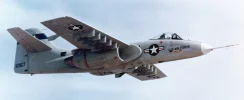
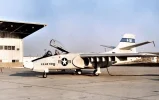
Here is the YA-9, Northrop’s contender in the close air support role fly off.

IMG_2218.webp

The two aircraft were almost identical in performance, mostly because the AF was very clear on the specifications. Northrop selected the new (experimental) Lycoming YF102 engine for the YA-9 rather than the more powerful General Electric TF34 used by the A-10. Both flew well, and test pilots even reported the YA-9 had mildly superior handling, but the USAF went with the A-10 primarily because the GE TF34 was a known engine with a solid history.

IMG_2219.webp
 
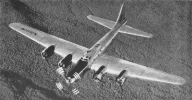
Another fun entry, the test bed for the The Pratt & Whitney T34 (Turbo Wasp) was a B-17.

IMG_2220.webp

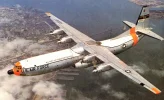
The engine was a Navy project but they passed on it. It ended up first of the Supper Guppy but primarily on the C-130’s daddy, the C-133 Cargo Master.

IMG_2221.webp
 
Here is the YA-9, Northrop’s contender in the close air support role fly off.

View attachment 46368

The two aircraft were almost identical in performance, mostly because the AF was very clear on the specifications. Northrop selected the new (experimental) Lycoming YF102 engine for the YA-9 rather than the more powerful General Electric TF34 used by the A-10. Both flew well, and test pilots even reported the YA-9 had mildly superior handling, but the USAF went with the A-10 primarily because the GE TF34 was a known engine with a solid history.

View attachment 46369
It always amazed me that form follows function re: it's SU-25 cousin!

Image-1-Su-25-Su-28-Frogfoot-Close-Support-Aircraft.jpg
 
While watching an episode of The Twilight Zone, the Royal Air Corps pilot takes off in 1917 but lands in 1959 at Lafayette Air Force Base in Reims, France.

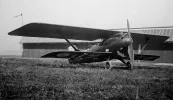
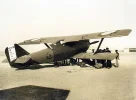
The first aircraft stationed there was the recon / bomber Breguet BR-19. The lower wing was substantially smaller than the top wing. It carried 4 .303 machine guns: 1 firing forward, 2 controlled after and 1 that could fire downward.

A successful design, it set several airspeed and altitude records in the 1920’s.


1792288948692.webp
The Breguet Br.19A2 two-seat attack bomber

1792289320816.webp
Breguet Bre.19 No.3, flown by French aviator Georges Pelletier d'Oisy, at RAF Hinaidi, India en route from Paris to Tokyo in 1924
 
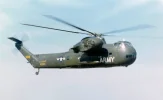
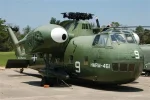
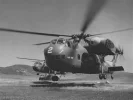
The hulking Sikorsky H-37 had 2 Pratt and Whitney R-2800 2100 HP piston engines (think F-4U Corsair) in sponsons feeding into a central gearbox - one of the first true heavy lift helicopters with a max gross of 31,000 lbs. There is an excellent display at the superb Evergreen Museum in McMinnville, Oregon.

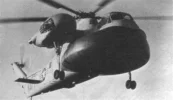
An experimental model HR2S-1W had an early warning radar and was easily recognizable.

1792636554838.webp
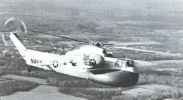
A H-37 Mojave of the US Army in flight
1792636598328.webp
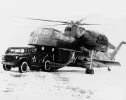
Loading a Dodge WC

1792636716049.webp
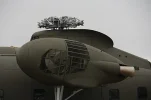
Closeup of the engine nacelle housing the Double Wasp radial engine on the Evergreen Aviation & Space Museum's Sikorsky CH-37B
1792636811701.webp
HR2S-1W
1792636883616.webp

1792636922295.webp

1792636960842.webp
 
The hulking Sikorsky H-37 had 2 Pratt and Whitney R-2800 2100 HP piston engines (think F-4U Corsair) in sponsons feeding into a central gearbox - one of the first true heavy lift helicopters with a max gross of 31,000 lbs. There is an excellent display at the superb Evergreen Museum in McMinnville, Oregon.

An experimental model HR2S-1W had an early warning radar and was easily recognizable.

View attachment 46401
A H-37 Mojave of the US Army in flight
View attachment 46402
Loading a Dodge WC

View attachment 46403
Closeup of the engine nacelle housing the Double Wasp radial engine on the Evergreen Aviation & Space Museum's Sikorsky CH-37B
View attachment 46404
HR2S-1W
View attachment 46405

View attachment 46406

View attachment 46407
I'm not a helo guy, But I have seen this bird up close and personal. What a beastly thing it is.
 
The hulking Sikorsky H-37 had 2 Pratt and Whitney R-2800 2100 HP piston engines (think F-4U Corsair) in sponsons feeding into a central gearbox - one of the first true heavy lift helicopters with a max gross of 31,000 lbs. There is an excellent display at the superb Evergreen Museum in McMinnville, Oregon.

View attachment 46401
A H-37 Mojave of the US Army in flight

There's one outside on the ramp behind the Naval Aviation Museum along with the other aircraft they haven't restored or put on display yet. She looks a bit worn but otherwise fine, I wish some rich former Naval Aviator gave the museum a boatload of money to restore and put those birds on display.
 
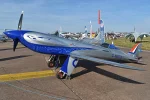
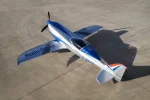
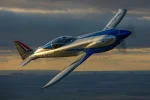
The fastest all electric aircraft is the Rolls Royce ACCEL which managed 345 mph. Will be curious to see how far this can go with the aerodynamic advantages it would have. Still a ways to go before reaching P-51 Mustang / F-8 Bearcat speeds in the low 500 range or the fastest propeller aircraft flying which I believe is the TU-95 Bear turboprop at 575 mph.


1792839977211.webp

1792840022659.webp

1792840060290.webp
 
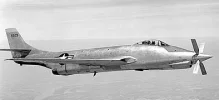
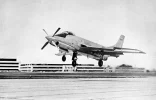
The McDonnell XP-88 Voodoo, specifically the “B” variant designed to test propellors for high speed (.95 mach) turboprops. One propeller actually reached a tip speed of 1.7 mach - curious to know what our TPS graduates think.


1792960989240.webp
Supersonic jet–turboprop hybrid XF-88B

1792961049875.webp
Landing the XF-88B
 
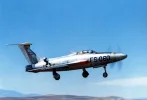
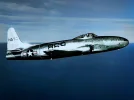
The Lockheed F-80 Shooting Star served in Navy/Marine service in the late 1940s. Three P-80As were transferred from the Army Air Forces to the Navy; one of these was fitted with arresting hook and was used for tests aboard USS Franklin D. Roosevelt (CVB-42).

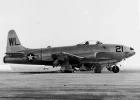
Then the Navy bought 50 F-80Cs and designated them as TO-1. Despite the T for training designation, 16 TO-1s were issued to VMF-311 in 1948, making -311 the first Marine jet squadron on the West Coast. VMF-311 transitioned to the F9F Panther a year later -- and took their F9Fs to war in Korea.

In August 1948 my dad picked up TO-1 buno 33868 at Van Nuys and ferried it back to Patuxent River where he was assigned to Tactical Test. The attached photo implies that Tactical Test had at least two of the TOs.

The pace picked up after that as the Navy/Marines bought 699 TO-2s. The O for Lockheed was soon changed to V and they serveed as
TV-2s in jet transition training units. In 1962 they became T-33Bs,

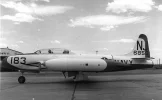
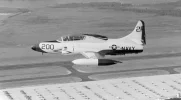
The final chapter of the story was the T2V-1 Seastar, which was an improved trainer that was carrier-capable. 150 T2Vs were used briefly as advanced trainers before being replaced by North American T2J-1 (new designation T-2A) Buckeyes. The T2Vs had more power, leading- and trailing-edge flaps and blown flaps, as well as a raised rear seat for better visibility. They ended their days as proficiency flight aircraft designated T-1A.

TV-2 RCVG-12 1958.webpT-1A.webp


TO-1 VMF-311 c1948.webpTO-1 NATC Tactical Test.webp
 
The Lockheed F-80 Shooting Star served in Navy/Marine service in the late 1940s. Three P-80As were transferred from the Army Air Forces to the Navy; one of these was fitted with arresting hook and was used for tests aboard USS Franklin D. Roosevelt (CVB-42).

Then the Navy bought 50 F-80Cs and designated them as TO-1. Despite the T for training designation, 16 TO-1s were issued to VMF-311 in 1948, making -311 the first Marine jet squadron on the West Coast. VMF-311 transitioned to the F9F Panther a year later -- and took their F9Fs to war in Korea.

In August 1948 my dad picked up TO-1 buno 33868 at Van Nuys and ferried it back to Patuxent River where he was assigned to Tactical Test. The attached photo implies that Tactical Test had at least two of the TOs.

The pace picked up after that as the Navy/Marines bought 699 TO-2s. The O for Lockheed was soon changed to V and they serveed as
TV-2s in jet transition training units. In 1962 they became T-33Bs,

The final chapter of the story was the T2V-1 Seastar, which was an improved trainer that was carrier-capable. 150 T2Vs were used briefly as advanced trainers before being replaced by North American T2J-1 (new designation T-2A) Buckeyes. The T2Vs had more power, leading- and trailing-edge flaps and blown flaps, as well as a raised rear seat for better visibility. They ended their days as proficiency flight aircraft designated T-1A.

View attachment 46440View attachment 46441


View attachment 46438View attachment 46439

There’s one of those wrecked out in the shallows at Wroten Island east of NAS Pax River. Fun little air field on that island.
 
Back
Top